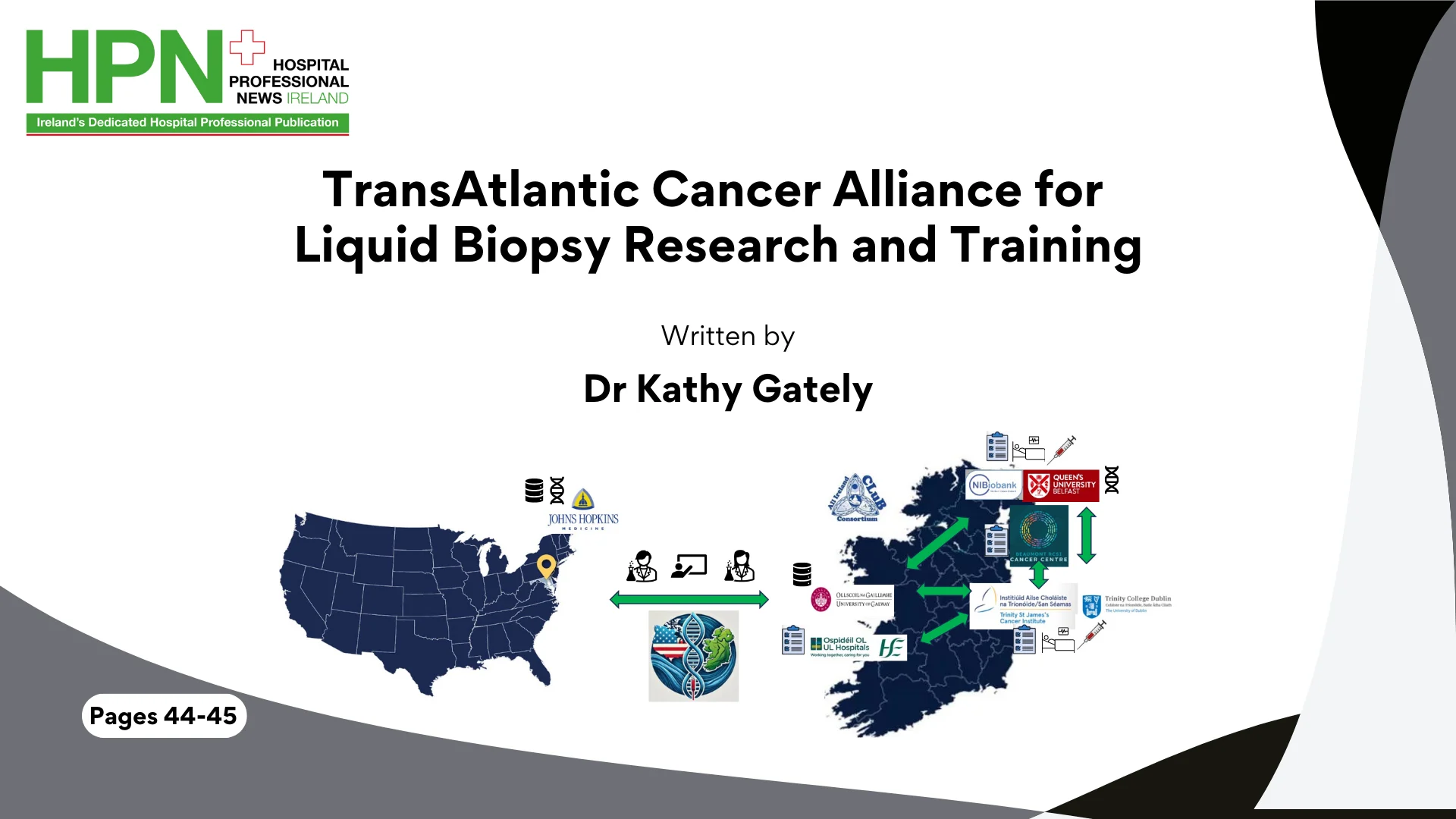
The TransAtlantic Cancer Alliance for Liquid Biopsy Research and Training project was recently funded by the HRB All-Ireland NCI Cancer Consortium (AICC) grant. This project, led by Dr Kathy Gately, a senior clinical lecturer at the Trinity St. James Cancer Institute (TSJCI) and colleagues, focuses on developing a network of liquid biopsy experts and data scientists across the island of Ireland in collaboration with National Cancer Institute (NCI) experts at Johns Hopkins University (JHU), Baltimore, US. The project was co-created in consultation with clinician scientists (Prof Patrick Forde (TSJCI/JHU) and Prof Valsamo Anagnostou (JHU)) and an All-Ireland team of thoracic surgeons (Mr Gerard Fitzmaurice and Mr Rory Beattie), pathologists (Prof Stephen Finn & Prof John O’Leary), clinicians (Prof Jarushka Naidoo & Dr Aidan O’Brien), translational research scientists (Prof Paul Mullan, Prof Lorraine O’Driscoll, Dr Ezgi Oner & Dr Sharon O’Toole), research nurse (Ms Sinead Hurley), patient advocate Mr Seamus Cotter, bioinformatician (Dr Pilib O’Broin) and the Northern Ireland Biobank. Each providing first-hand knowledge of the needs of the Irish health research and services system North and South. The project will hire a research assistant and post-doctoral fellow who will initially focus on advancing liquid biopsy research for patients with lung cancer with the goal of expanding to other cancer types.
The liquid biopsy (LB) has emerged as an important minimally invasive tool to detect micrometastatic disease and assess changes longitudinally at more frequent intervals. The LB tumor circulome comprises circulating tumor cells, tumor DNA (mutated/methylated), RNA, proteins and extracellular vesicles (EVs) that are shed from the tumor and are implicated in various cancer processes. Cell-free DNA (cfDNA) released into the blood due to apoptosis, necrosis and phagocytosis is known as circulating tumor DNA (ctDNA) when it originates from tumor cells. ctDNA is the most extensively studied component of the LB and is used to identify patients harboring minimal residual disease (MRD) following curative treatment and guide the administration of adjuvant therapy. Our goal is to co-analyse the multiple LB components in longitudinal patient samples.
For verified healthcare professionals
Log in or register for free to read this article. HPN is for healthcare professionals, so new accounts are verified by our team.