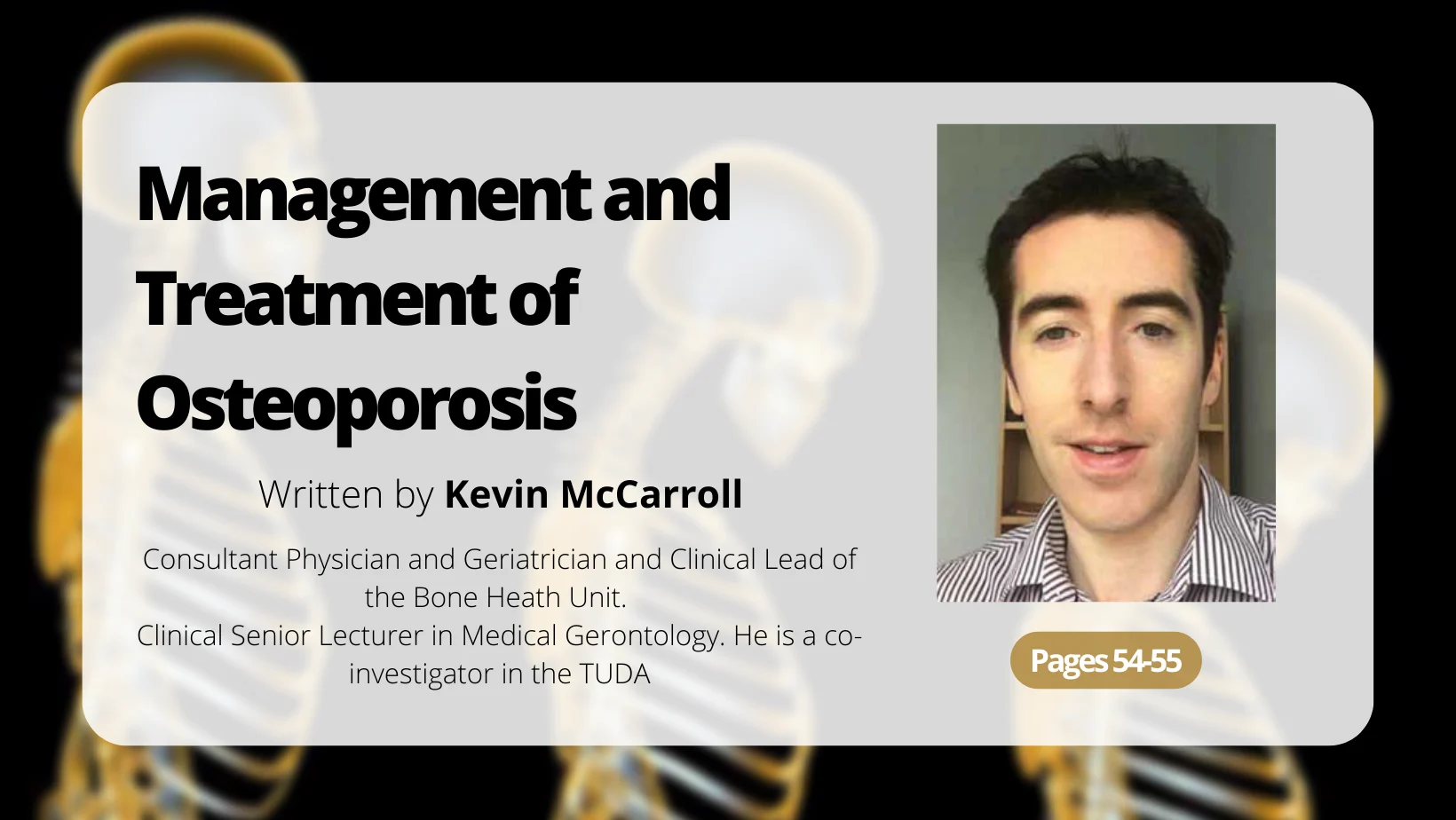
Dr Kevin McCarroll is a consultant physician and geriatrician specialising in osteoporosis at St James’s Hospital, Dublin where he is a Clinical Lead of the Bone Heath Unit. He also co-runs the orthogeriatric service and is a Clinical Senior Lecturer in Medical Gerontology at Trinity College. He is a co-investigator in the Trinity, Ulster, Dept Agriculture (TUDA) study of over 5000 patients in which research on bone health and vitamin D is being conducted.
Osteoporosis is common and affects an estimated 300,000 people in Ireland. It is defined as decline in bone mass associated with a microarchitectural deterioration in bone resulting in increased risk of fragility fracture. In practise, the diagnosis can be made when the lowest T score on DXA is ≤-2.5 at any of three sites (total hip, neck of femur or lumbar spine). However, a clinical diagnosis of osteoporosis can also be made without bone mineral density (BMD) measurements in patients who have a fragility fracture of the hip or spine. Fragility fracture is one that occurs from a fall from standing height or due to trauma not normally expected to cause a fracture. Osteopenia is defined when the T score is between -1.0 to < -2.5. In premenopausal females and males aged under 50, a Z score < -2.0 indicates low bone mass which may due to osteoporosis though other causes such as osteomalacia need to be considered.
For verified healthcare professionals
Log in or register for free to read this article. HPN is for healthcare professionals, so new accounts are verified by our team.