Minimally invasive surgery (MIS) for abdominopelvic disease has been available for patients now for over three decades in the form of laparoscopic or “keyhole” surgery. It has proven beneficial for patients in terms of postoperative recovery with less wound complications and less chance of peritoneal adhesions as well as shorter hospital stay and faster return to full activity rates. More recently increasingly sophisticated and expensive hardware platforms in the form of Robotic Assisted Surgery have been added to the MIS option to allow surgeons perform operations in a similar fashion to those now commonly done laparoscopically with added technological capability such as allowing the on-screen visualisation to be controlled directly by the operator, the provision of immersive and often 3-dimensional viewing and, perhaps especially, highly articulating instrument tips. An example of how articulating tips could be an advantage is suturing. Whereas the more standard laparoscopic needle holder devices simply open and close at its end where the needle is grasped with the instrument shaft itself being a straight, rigid “stick”, in robotic surgery, the end effector of the instrument has “degrees of freedom” of movement allowing for various angulations and rotational movements relative to the shaft making it easier to perform tasks needing finer detail. It is hoped that these technological capabilities will overtime allow more complex operations be envisaged and/or that existing MIS operations can be done more easily by surgeons trying to learn operations.
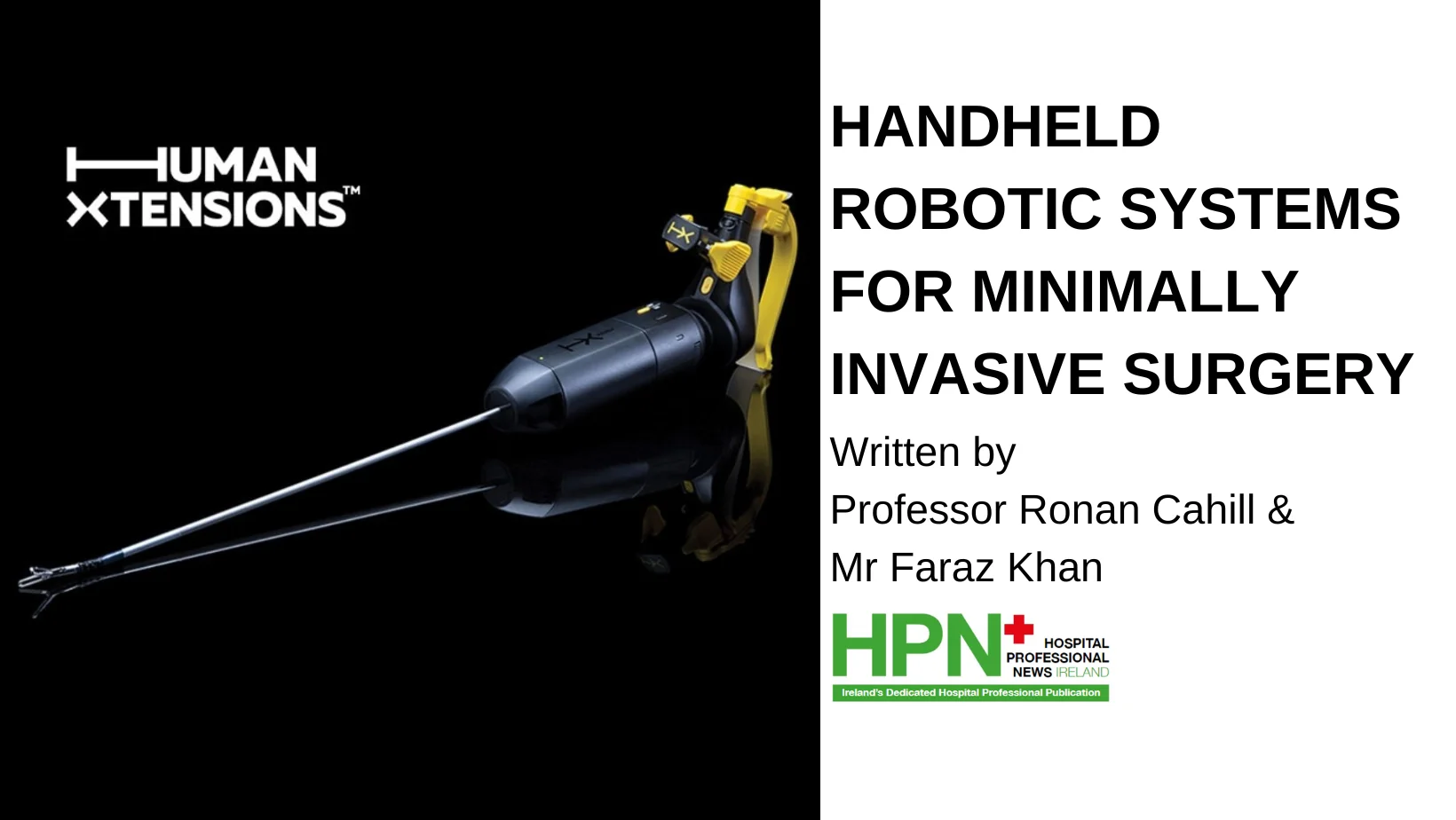
In the last 5 years there have been additional auto-mational advances in laparoscopic surgical instrumentation aimed at obviating the need for great investment in time and capital expenditure associated with current incumbent large-scale robotic platforms. This has enabled articulating end effectors for handheld instruments allowing for robotic-like dexterity and manoeuvrability within the standard MIS set up and workflow. While this capability can be achieved to some degree by clever mechanical engineering alone, miniaturised electromechanical motors are now available that can “robotise” instrument tip movement making for intuitively controlled fine movements. HandX™ by Human Xtensions is the first CE marked computerised smart software driven laparoscopic instrument that gives the same degree of control and articulation as one would get in robotic surgery but that also fits immediately with standard laparoscopic workflows, set-ups and indeed pricing. This device is lightweight and compact and so can be operated handheld. Its provided with single-use, detachable end effectors (so far, the range of instruments include Fenestrated grasper, Needle holder, Monopolar hook, Monopolar spatula, Monopolar scissors, Self-Righting needle holder) that make it suitable for a wide variety of surgical approaches and surgical environments allowing it offer a new niche between standard laparoscopic surgery and the now “traditional” robotic platforms without the problem of over-functionality. Simpler operations so can be performed more simply then the robotic equivalent while more complex laparoscopic procedure can be augmented by focussed application of the necessary technology capability just for the specific part requiring it. The disposable component aspect of the instrument cuts down on maintenance contracts and the learning curve is that of a single instrument that can be applied to a variety of operations rather than needing a wholly changed procedural workflow across a spectrum of surgeries and even specialties. The minimal set up time enables fast procedure turnover and the device itself is comfortable to use single handedly. Importantly, the device can be used with existing small, 5mm trocars and can be utilised via existing port positions. Our journey of adoption of this handheld smart instrumentation began in December 2021 with initial team training in the use of HandX in learning sessions in our in-hospital dedicated surgical skills and development lab at the Mater Misericordiae University Hospital and a further session in the national surgical skills centre RCSI building on our prior experience with purely mechanical handheld articulating devices (namely FlexDexTM). The technology was separately also introduced including practical sessions to senior surgical trainees at the RCSI as part of a New Technologies training day. Such training sessions comprised of hands on training on a laparoscopic box trainer for the surgeons using the device. Immediately after our intensive training, with hospital approval, a series of operative cases were carried out over three days including elective & emergency surgeries (appendicectomies, cholecystectomy, intestinal stoma formation and cyst excision) where the device was used alongside existing laparoscopic surgical instrumentation after additional dedicated theatre team training for the set-up of the device. Following this initial experience, two shorter subsequent three day periods of HandX™ access were enabled in February & October 2022 allowing additional cases to be done including a series of Transanal Minimally Invasive Surgery (TAMIS) for significant rectal polyps and early cancer. Overall the device was successful deployed in three different theatres in two different hospitals (including our elective and emergency theatres in MMUH and one in Mater Private Hospital) with it being obvious to all how easy it was to move between the various locations, and most importantly, transfer the necessary set-up skills between the different theatre staff supporting the surgeries. Each time we used the device for a period we ensured there was a recap session, practice and access to our surgical skills lab including in particular simulation of TAMIS procedures. Along with the essential review and practice run for the operators, there were also additional demo workshops for other consultant colleagues and surgical trainees.
For verified healthcare professionals
Log in or register for free to read this article. HPN is for healthcare professionals, so new accounts are verified by our team.